
For a lot of North Saanich, summer comes with a quiet calculation running in the background: how much rain fell last week, how the well is holding up, and how dry the yard has gotten. That calculation is especially familiar in the district’s rural and agricultural pockets, around Ardmore, Lands End, and the farmland near the Sidney boundary, where private wells rather than municipal lines supply the household. When the rain stops, the well becomes the thing you start watching.
North Saanich FireSmart and Bethany Couture of Garden Alchemist are hosting a free workshop on wildfire-resilient gardening, Sunday, June 28, from 1 to 4pm, covering high-risk plants to avoid, fire-resilient alternatives, and how mulch, hedges, and layout factor into a more drought- and fire-tolerant yard.
What Firescaping Looks Like
Firescaping isn’t about clearing a yard bare. It’s about choosing and placing plants so fire has less fuel near the house. Fire-resilient plants tend to hold more moisture, carry fewer flammable oils, and shed less dead litter.
A simple way to think about it by distance from the house:
- Closest in (0 to 1.5m) low, high-moisture plants like hostas, peonies, and yarrow.
- Mid-zone (1.5 to 10m) deciduous shrubs and spaced perennials, such as dogwoods, mock orange, and native salal.
- Outer zone (10 to 30m) thinned trees and well-spaced shrubs like rhododendrons, rather than dense, unmanaged growth.
Deciduous plants generally beat evergreens here since they hold more water and lack the resins found in many conifers. Black-eyed Susans, echinacea, coreopsis, bee balm, and sea holly are other solid, low-fuel options.
Where Water and Fire Safety Meet
A few habits help on both fronts: keep mulch away from the house, since dry bark mulch against siding is itself fuel; clear dead wood regularly, even on fire-resistant plants; and consider rainwater harvesting, so a defensible space has something to draw on in the driest weeks without leaning harder on an already-stretched well.
None of this means starting over, just a few swaps and a little more attention to what sits closest to the house.
Sources:
https://northsaanich.ca/firesmart
https://apps.nrs.gov.bc.ca/gwells
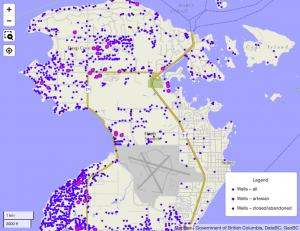
Check out this interactive map where you can view all the registered wells in BC.


